Blogs > Cooking from Scratch

Chef Stacy believes that cooking from scratch and using the best ingredients are the secrets to preparing delicious and memorable meals. She has created dozens of classes for the home chef and teaches students how to master culinary techniques and recipes in just one session. Read on to see what she's dishing up for The Oakland Press today....

Monday, May 2, 2011

All Who Wander are Not Lost

A couple weeks ago, some friends from the Oakland Press stopped by Mirepoix for an informal cooking demo. Stephi Hill, the online host of The Community Wanderer, helped me put a delicious impromtu dessert together, perfect for almost any occasion; Bananas Foster. You can watch our demo here.

I hope some of you will also wander over to Mirepoix for a hands-on class soon!

Labels: , ,

Saturday, March 5, 2011

French Flair

Rainy days like this remind me that Spring is just around the corner and that the winter thaw is sooner than we think (or so I hope). Crepes are traditional French fare, and as I look out my office window, I think fondly of a good friend who lives in Paris, who also adores crepes.

Tonight, one of our clients has reserved the Mirepoix classroom for a private event and has selected our French Flair menu for his guests. Crepes Suzette will be prepared and served with vanilla bean ice cream. Just as our students learned on Wednesday night, our guests tonight will see that crepes are an impressive dessert that they can prepare at home in their own kitchen.

When I was about 7, my mother had a crepe machine that resembled an electric frying pan. It was tan and had a handle, which had a cord that plugged into the outlet. She would allow the machine to heat and then ladle some crepe batter onto the surface and it made the most beautifully colored crepes which she served with fresh strawberries and whipped cream.

I've lost track of where her machine is, but crepes are easily prepared in a small non-stick pan, using some melted butter.

If you'd like to recreate the recipes that will be featured at tonight's party, you can view the recipe on our Facebook page.

Labels: , , , , ,

Saturday, December 11, 2010

Yule Tide Cheer

When I graduated from college, and made my departure from the Golden Mushroom, I took a pastry chef position near my home - so close, I could run there. In many ways, this was a perfect place for me to work - and at that time, the best job I had ever gotten for several reasons: I was compensated nicely, my commute had been reduced from a 45 minute hellish treck via 696 east to The Mushroom, I had my own pastry shop, complete with operational equipment,all in the basement of a beautiful old building in downtown Milford. I enjoyed complete autonomy, and, as I said, I could run there when weather permitted.

I was hired by a gentleman who had gone to the CIA in New York, and had become a pretty successful restauranteur. He owned several restaurants, as well as a catering company. He was full of life and had lots of personality. What I liked about him was that he was straightforward and pretty hands-off. He treated me well, always with respect, and made a sincere effort to make me feel a part of the family. Not just the family of restaurant employees, but his family as well.

Around the holidays, he stopped by my bakeshop and talked to me while I made scones and creme brulee, and listened to Spartan basketball. He was really excited about the holidays and he wanted us to build a gingerbread house and make a Yule Log for his annual holiday party. We drew up the templates and he enthusiastically showed me the best way to get everything "just right" so that my gingerbread house would be sturdy enough to withstand the jostling of 100 people crammed in his house, laughing, drinking and reminicing about the highlights of the year gone by.

He also invited me over so that we could decorate additional gingerbread houses with his wife (who was a tremendously classy and kind woman; I admired her greatly), and kids. Though I was a culinary school graduate, I had never learned to make a gingerbread house, and I was grateful for the lesson, and more grateful to be treated so nicely.

To this day, Yule Logs & Gingerbread Houses are a part of the holiday season that I enjoy, and actually believe are worth the effort, and sometimes, aggrivation. For that reason, I offered a class at Mirepoix called, "Show Stopping Holiday Desserts". To my absolute delight, two of my students had traveled all the way from Bay City to take our class! Talk about effort! We had a wonderful time and their Yule Logs were beautiful.

Making a Yule Log is not difficult, however, it is time-consuming. Today, we made our sponge cake, then our chocolate & praline buttercream. No Yule Log would be complete without the whimsical meringue mushrooms, dusted lightly with cocoa powder! Our students did a fabulous job, using a pastry bag to make the mushroom caps and stems. To really add definition, texture and interest to our logs, we rolled out chocolate fondant, cut it into circles, and used tempered chocolate to make rings for the "exposed" trunk and branches.

If you would like to make your own Yule Log for this holiday season, take advantage of our Make & Take Yule Log class on December 22 from 11 am - 3:30 pm. You'll receive instruction from our chefs, all of the recipes, and, your own Yule Log to take home to share with your family and friends.

To view photos of the Yule Logs prepared in today's class, "Like" us on Facebook.

Labels: , , , , , , , ,

Saturday, September 4, 2010

A Pirate's Life for Me

As I sit at my desk, preparing for tonight's Famous Local Restaurants class at Mirepoix, I run through all of the recipes I want to feature in our recipe packet. When I reflect on my time at The Golden Mushroom, I can't help but smile when I reminisce about the completely unreasonable state of the kitchens, the hilarious and varied cast of characters, the everyday stresses of working in a professional kitchen(which were exponentially increased by the spontaneous and unexplainable defrosting of our walk-in freezer) or the time I got so stressed out, I broke out in hives and had to run out to the drug store in the middle of my shift(funny - now the former site of the Golden Mushroom is a CVS). Good times. Really.

Though I have a true fondness for restaurants and their never-ending outrageous pace, many people ask me if I want to own my own restaurant, and my answer has always been (without hesitation) "NO!". My little nook in the food industry here at Mirepoix is my dream; I'm doing what I always wanted to do but could never quantify until I got here. Still, sometimes, I miss the frenzy, chaos, mayhem, and pirate ship mentality of a working kitchen.

Restaurant life is not for everyone. My father owned a Ram’s Horn restaurant in the 70’s and hated “the business” so much, he sold his interest to his partner for a dollar. He went on to pursue other opportunities and refers to the two happiest days of his life as, “the day he bought the restaurant and the day he sold it” (I’m sure his marriage to my mother and the birth of each of his children, are implied, though not enumerated).

Just over 20 years later, I announced that I would be attending culinary school and quitting the family business. My parents, certain that I would never actually quit, my ignored my formal and written resignation, and after I finished my 2 week’s notice, everyone was amazed when I really did stop coming into work.

Culinary school was a revelation. After graduation, my career in “the business” began. 5 Lake Grill, Café Bon Homme, Gravity Bar & Grill, and The Golden Mushroom were all ports on my tour of duty. Each place had its special little brand of "crazy".

Sadly, after the 90’s drew to a close, and “The Big 3” and other major players (advertising execs, law firms, etc.) put the crack-down on expense accounts, fine dining (what little of it we actually had) in Metro Detroit took a major, and unfortunately, almost fatal hit.

Famous Local Restaurants is our way of acknowledging and paying tribute to the places where many Metro-Detroiters celebrated life’s accomplishments, anniversaries, birthdays and other special occasions. It’s our way of celebrating the chefs who taught us so much, such as Brian Polcyn, and of course, “The Godfather”, Milos Cihelka (just to name a couple). Real chefs, real trend-setters, and most importantly, real mentors.

We offer this class a couple of times a year. Should you ever decide to take it, I hope you enjoy it as much we enjoyed working in 100 degree kitchens at a break-neck pace with the chef breathing down our necks, loud cursing in the background and no end in sight; you have my word we won’t yell at you and it's significantly cooler in our kitchen.

Labels: , , , , , ,

Wednesday, July 28, 2010

If It's Not Food - Don't Eat It!

Saturday morning on my way into the office, I noticed a sign for grass-fed beef at my neighborhood makeshift Farmer’s Market. Many of you know that I have real reservations about, and mostly abstain from, eating meat and poultry, for numerous reasons, ranging from animal welfare, economics, to unabashed food-snobbery.

As a chef, I’m passionate about good food, of course, perhaps bordering on somewhat of an obsession. From a political or economic standpoint, the issues of food quality, point of origin, processing, distribution, and consumption can be so complex on so many different levels (which we’ve very briefly explored in previous blog posts). Because our first love is our love of food, we offer almost any kind of class you can imagine. Tonight as I type my blog, the wonderful aroma of garlic and onions are wafting underneath my closed door, as the students in the classroom are learning about vegan & vegetarian cuisine.

At Mirepoix, we believe that good health, quality of life, and excellent tasting food can all be enjoyed simultaneously. Surrounded by conflicting and sometimes complicated messages about food and nutrition, we strive to help people to make educated choices.

Over the years, we’ve all been inundated by fad diet philosophies (low fat, low carb, Sugar Busters, vegetarian, raw food, vegan, etc.) only to find out that a new plan will hit the Best Seller list. Good foods, bad foods, on and on. The Mirepoix Cooking School credo is simple – If it’s not food, don’t eat it!

Sounds over-simplified, but it’s true. The American diet has shifted from eating whole, natural, and local (or even home-grown) foods, to consuming more than half of our daily calories from processed, packaged foodstuffs made in a factory somewhere. Most of the meat and dairy products we consume in this country are raised, produced, and processed in a manner that would appall and disappoint almost any responsible human.

At Mirepoix, we have very strict and straightforward quality standards for our ingredients (we use natural & cruelty free meats and dairy products, and choose local ingredients & products whenever possible).


Now more than ever, there is a serious disconnect from the source and origin of what we pile onto our plates. Behind even the most ubiquitous shrink-wrapped boneless skinless chicken breast is a story, and most of the time, you wouldn’t want to hear it.

The good news is, you have choices!

When people hear “vegetarian”, they typically think of tofu and other meat substitutes. I, however, always stress the opposite. Many people decide to “go veg”, and their eating habits sometimes become worse than the habits they held to before! Many people on a vegetarian diet tend to eat too many carbohydrates and processed foods, rather than the healthy whole foods they need.

Tonight’s class has a recipe that features tofu and soy milk (vegan chocolate cupcakes). Typically tofu, temphe, seitan, and other “meat replacements” are more processed than I personally prefer. If my ultimate goal is to eat “real food” or “responsible food”, for me, these things do not fall into that category. Though I am a supporter of animal rights, and anti-animal cruelty, I would prefer to eat a naturally raised, free-range, non-commercially processed local chicken than to eat faux chicken or something out of a package. Stricter folks than I would never consider eating animal protein, and for them, there are other excellent and healthful ways to keep protein in their diets.

Soy milk is often flavored and high in sugar. The only soy milk we use in our classes is Eden Unsweetened Soy Milk (although I prefer West Soy plain). For me, soy “cheeses” are completely out of the question and I would NEVER, from a chef’s or a natural foodist’s perspective cook them, eat them, or recommend them.

Because or starting point is our genuine love of food, all of our cooking classes feature nothing artificial, and very few “reduced fat” items. Instead, we reduce the amounts of full fat ingredients where appropriate, and compliment them with naturally lower fat (read: not chemically stabilized) ingredients.

When you’re a chef, having access to all of this incredible food can be a dangerous thing! Most of the staff at Mirepoix watch our waistlines for practical reasons. 4 cooking classes a week can add up to some SERIOUS calories! For those of us who still want to enjoy great tasting food, without compromising the integrity of the dish, we eat less of the full-fat stuff and know that we can be satisfied with just a taste or two. We believe in moderation, quality, using proper cooking techniques, and stressing ingredient knowledge, so that we can make delicious recipes everyone can enjoy.

Many can rightly argue that eating better quality food (unprocessed) is expensive and out of reach for many. I will never argue against that point, or try to marginalize the desperate economic restraints that impact the quality of food served at the dinner tables across our country and all over the world. The economics of the plate can be complicated, but, for the purposes of narrowing them for the average middle-class American, responsibly raised and produced food can be within reach.

Because I feel so strongly about the quality of the food I eat and serve, and the story behind it, there are certain things I will not buy. Personally, I do not buy Land O Lakes dairy products because reports have shown that their treatment of livestock is inhumane (and that’s being polite). This doesn’t mean that I buy excessive amounts of expensive European style butter to stock my fridge at home, or even pounds and pounds of the pricier, but local “Calder’s”. It simply means that I spend my money on what seems appropriate, and I use it sparingly. There is also an innate ability that chefs have to enjoy pure food and its nuances (real food without all of the butter and salt!)

There is a notion in America that we “need” to eat heavy portions of meat and other animal products, and we’ve even fooled ourselves into thinking that it’s good for us. The fact is, a true serving size of animal protein is much, much smaller than what we typically eat (think 2/3 less) or “need” to feel satisfied. With the money spent on all of the extra, mass-produced chicken you don’t really need, you could buy (albeit less) higher-quality, more responsibly raised and processed ingredient(Bell & Evans, or a local farmer, etc.).

Of course, these are just our recommendations and guidelines, and I’ve only superficially scratched the surface of the economic, political, and social issues surrounding this topic. Regardless of what we recommend, you will make the best selections in your kitchen at home, based on your unique lifestyle.

Whether flexitarian, vegetarian, vegan, or omnivore, focus on flavor, good food, and moderation, and your body will run like the beautifully designed machine it is.

Don't forget about our Cooking From Scratch Recipe Contest! The deadline for entry is August 7!

Labels: , , , , , , , ,

Monday, July 19, 2010

Celebrate the Chef in You

I came to Holiday Market almost four years ago with a very specific mission – to teach people to cook and think like professional chefs. Sounds, easy, right? Surprisingly, it is much more difficult than I thought it would be! My boss, Tom Violante, Jr. is an extraordinary person (I mean that in all sincerity, not just because he sometimes reads my blog) who leads with vision and an innate understanding how to support the people who work for him.

Mirepoix was Tom’s idea, and a brilliant one at that. The entire concept was something that he had been thinking about for a while, and one day, we met to talk about it. It took me several months to wrap my mind around what he was asking me to do. I’m incredibly literal and specific and Tom is into “the big picture”. I, being a complete pain in the ass, gave him the run-around for a while, since I didn’t quite see the opportunity in its entirety (which was incredibly dense on my part). Finally, Tom called me out (if you know me, this earns you major respect in my book) and I took the job. Subsequently, it was the best decision I’ve ever made.

So here we are, almost 4 years later, our cooking school past its infancy and growing pains. After some trial and error, I’m now blessed with a staff of incredible chefs and assistants, and I can finally breathe just a little bit easier. Still, I’m not ready to rest. The business of professional cooking is honestly, a brutal one. My own father once owned a restaurant and still says that the happiest day of his life was the day he sold it. My dad is a tough guy, so if the restaurant business gave him hell, that’s saying something.

We teach all kinds of classes at Mirepoix, from knife skills to couples classes. At the outset, each class was formatted in a way that offered something for all ability levels, so that no matter how unskilled or advanced you were, we had just the right recipe project for you. My original vision for Mirepoix was to offer professional culinary instruction for the person who longs to cook like a professional, but doesn’t have the time to invest in pursuing a culinary degree.

Realizing this vision has taken time, but we have now grown to the level where I can finally offer 3 distinct categories of classes; open ability (the same format we’ve always offered), theory-hungry (beginner to foodie- but an obsession with food theory is a must), and advanced.

This month, we introduced a new series called, “What I Learned in Culinary School…”

This series is designed for the student who may be curious about professional cooking, but not sure if it is right for them, or, the student who longs to attend culinary school, but doesn’t have the time or resources to make that dream a reality (this fits into the “theory-hungry” category). Our first class, “Boot Camp” was last night. Each class in the series is limited to 8 students because the level of instruction is much more intense than our other classes.

Our agenda last night focused on basic knife skills, very basic butchery, and stocks. We discussed the theory of cooking and explored all of the little details that are essential for success in the kitchen, whether you’re a novice or an accomplished foodie. After over 600 classes taught at Mirepoix, this was far and away my favorite.

Building on what we learned last night, our next class will focus on using stocks to make sauces. The lessons are taught straight from our textbooks and notes from our days as eager culinarians at Schoolcraft College, making the agenda for each class very ambitious. Starting in October, I will be offering an advanced series for people who are looking for something even more intense. This series will also be limited to only 8 students.

Moving into this new phase of development is incredibly satisfying and exciting. As excited as I am about the two new class categories, you have my word that our commitment to excellent instruction, great tasting food, and a friendly and fun atmostphere will still be a part of our curriculum, and our core category of classes will not fall by the wayside with this new chapter.

We have an unbridled enthusiasm for teaching the home gourmand how to cook like we do. We are technique driven – not recipe driven, passionate about food I love the personal touch that we add to the experience. Those things, as long as I am here, will never change. In the meantime, though, if you’ve been dying to celebrate the chef in you, but didn’t know how, consider signing up for a few of the classes from the Culinary School series.

Also, don’t forget about our recipe contest! To learn more about the contest, click here.

All entries must be emailed to me at stacysloan@holiday-market.com. Good luck!

Labels: , , , , , , ,

Saturday, July 17, 2010

Announcing the Mirepoix Cooking School Cooking from Scratch Recipe Contest!

Even as a five year old, I was monumentally unimpressed with going to school everyday. The only highlight was riding on the bus, my first glimpse of freedom and independence, which lasted only a few short moments since we lived so close to the school. While my kindergarten pals happily sang songs, put puzzles together and learned to spell basic words, I remained (not surprisingly) uninterested and somewhat belligerent. Then one day, something really great happened. My first food memory was born.

Someone’s mom came in, armed with tiny foil loaf pans, cooking spray, and ingredients to make a tasty loaf of warm, refined white flour goodness. I even remember the recipe. It was a small little booklet with a red cover that had a hole punched in the left corner and was tied with a red ribbon.

Several times at home, I tried to recreate the bread, which proved a real challenge, especially since, somehow, the recipe was lost. Every attempt I made ended in disaster, but whatever I missed out on in terms of tasting the wonderful bread, hot from the oven, I made up for in enjoyment. It didn’t really bother me that the bread failed every time I tried – half of the fun was in making it!

Anyone passionate about food has a food memory, or, maybe lots of them. Since I was a young child, I knew instinctively that cooking from scratch was worth the effort. Fast forward 25 years... cooking from scratch is still worth the extra effort, and, is more important than ever.

Starting today, you can register in the Mirepoix Cooking from Scratch recipe contest.

To learn more about the contest, please click here:

Once you’ve decided which of your signature recipes you’d like to enter, email them to me at stacysloan@holiday-market.com Please be sure to follow all of the guidelines for submission, as outlined on the Oakland Press page. Incomplete entries will be immediately discarded.

I’m looking forward to reading your recipes. Feel free to also tell me why your recipe is so special to you.

Labels: , , , , , ,

Friday, July 9, 2010

A Peach of a Coffee Cake

This afternoon, prior to coming into the office, I opened the fridge and saw the following ingredients: lowfat sour cream, organic eggs, rhubarb and peaches.

Knowing that soon, all of that gorgeous fruit would spoil, I decided to make an impromptu coffee cake. My pantry contains whole wheat pastry flour, muscovado sugar, raw sugar, vanilla bean paste, sea salt, and the appropriate leavening agents.

Here is the recipe. Feel free to try the recipe with white flour and sugar if you prefer.

Fruit Mixture:
1/2 lb. sliced peaches
1 lb. sliced rhubarb
2/3 c. raw sugar
6 tsp. cornstarch
1/4 tsp. salt
Method:
Combine all of the above together and let sit for at least 15 minutes. Then dump into a greased 9X13 baking dish.

Cake Mixture:
2/3 c. lowfat sour cream
4 egg yolks
4 eggs
2 Tb. vanilla bean paste (you can substitute vanilla extract)
4 c. whole wheat pastry flour
2 c. raw sugar
2 tsp. baking soda
2 tsp. baking powder
1 tsp. sea salt
6 oz. softened butter
Method:
In the bowl of a food processor, I dumped in the raw sugar. I gave it a few pulses to break the large crystals down to something more suitable for cake-making. The crystals never got to be as fine as granulated, but they were relatively close. I then added the rest of the dry ingredients.

In the bowl of a large stand mixer, I dumped in the contents of the food processor (flour, sugar, salt, soda/powder). Use a paddle attachment. Then, alternately, I added eggs and sour cream. After all of the eggs and sour cream were incorporated, I added the softened butter and vanilla paste. Be careful not to over-mix this, or else the cake will be really heavy. Spread this mixture over the fruit.

Crumb Mixture:
1/3 c. brown sugar
1/3 c. raw sugar
1 tsp. cinnamon
1/4 tsp. sea salt
4 oz. melted butter
1 3/4 c. whole wheat pastry flour
Method:
combine all ingredients together until they form loose crumbs. I added some homemade granola that I had kicking around in the pantry (in my granola, I use oats, maple syrup, unsweetened coconut & pecans). This is totally optional, and mostly for your reference. Sprinkle the crumbs on top of the cake batter.

Bake at 325 until a toothpick inserted into the middle comes out clean (mine took over one hour). If the crumbs look too brown, but the cake still isn't done, cover the crumbs with foil.

Cool. Serve at room temperature.

Labels: , , , , , , ,

Monday, July 5, 2010

Prime Time - The Next Food Network Star

I happened upon an episode of ‘The Next Food Network Star’ last night. I’ve never seen the show (you can look for my professional perspective if you visit my other blog, ‘Motor City Food’ in the coming days) when I heard one of the contestants describe a “prime” cut of steak as “the cut just under the quality of a filet.”

Ouch.

Enter the Mirepoix Cooking School class, ‘Meat Counter 101’, which will debut July 14. Many people enjoy a great steak, but do you know what makes a steak, well, great? What chefs know (unless they’re a contestant on ‘The Next Food Network Star’) is that all steaks are not created equal.

Why do steaks cost so much less at Sam’s Club and Costco, or Kroger, for that matter? Why does a steak at Holiday Market come with a slightly higher price tag? The reason is simple; our meat is “certified premium”; which is a classification that indicates the marbling, the grade, the regulation of antibiotics, as well as the age of the cattle at the time of slaughter.

There are several different grades of beef which are outlined by the USDA, which you can read about below.

Although there are eight levels of USGA graded beef there are generally only three USDA grades of beef that you would buy in a supermarket, a butcher shop or a restaurant. They are USDA Prime, Choice or Select which is the order of grade from the highest to lowest.

USDA Prime is the superior grade with amazing tenderness, juiciness, flavor and fine texture. It has the highest degree of fat marbling and is derived from the younger beef. That's why Prime is generally featured at the most exclusive upscale steakhouse restaurants. A prime steak isn’t a cut of meat like a tenderloin (filet), or a strip.

USDA Choice is the second highest graded beef. It has less fat marbling than Prime. Choice is a quality steak particularly if it is a cut that is derived from the loin and rib areas of the beef such as a tenderloin filet or rib steak. Generally USDA Choice will be less tender, juicy.

USDA Select is generally the lowest grade of steak you will find at a supermarket or restaurant. You will find it tougher, less juicy and less flavorful since it is leaner that Prime and Choice with very little marbling.

Mystified by all of the choices our Holiday Market meat counter has to offer?
Consider our Meat Counter 101 class. From beef, to lamb or chicken, this class will bring you the basics of the butcher shop and help you understand which cuts are best for which recipes and preparations. We’ll practice our knife skills, learn some basic butchery techniques and then prepare some of our favorite dishes featuring our selections from the Holiday Market Meat Shoppe.

To register, visit our websitea at www.mirepoixcookingschool.com

Labels: , , , , , ,

Wednesday, June 30, 2010

Celebrate Summer with a Blue Ribbon Pie

With the 4th just around the corner, you may be considering the perfect dessert for your holiday picnic. Everyone loves a homemade cherry, apple or banana cream pie. If you think that perfect pastry is out of your reach, it's not! Follow the tips below and you'll be wondering why you haven't tried making your own pie crust before!

Pie Crust – A Crash Course
There are several things to keep in mind when you set out to create a flakey, delicious, and simple pie. One of the most intimidating undertakings for even a very accomplished baker, pies do not need to be so complicated. Learn a few simple tricks, develop your technique, and you will turn out perfect pies every time.

The Ingredients
Flour – Choose pastry flour when making pie dough. It has the appropriate amount of gluten to ensure the proper texture.

Fat – Lard, shortening, and butter are the best choices when making pie dough. Most bakers like to use a combination of butter and shortening/lard because butter lends a delicious flavor and texture, but shortening/lard shrinks less. If all butter is to be used, then you should add 25% more butter. For instance, if a recipe calls for 1# of shortening, use 1.25# butter.

Liquid- water is necessary to develop some of the gluten in the flour, and to give structure and flakiness to the dough. If too much water is added, the dough will become tough. If too little water is added, the dough will fall apart.

Salt – Salt has some tenderizing and conditioning properties. Dissolve salt in the water to ensure even distribution.

Temperature
All ingredients should be ice cold, it is even beneficial to put the mixing bowl in the freezer until you are ready to start working.

Tools Commonly Used in Pie & Tart Production–
Inexpensive bench brush (buy at a hardware store, use only in kitchen)
Pastry brush
Bench Scraper, metal
Aluminum pie pans
Kitchen Shears, for pastry use only
Rolling pin
Saran wrap
Fork
Tart pans
Half sheet pans

Combination Pastry
1lb. 9 oz pastry flour
2 tsp. Kosher salt
1 lb. chilled unsalted butter
5 oz. shortening
2/3 c. ice water

The Pastry Method:
Scale all ingredients accurately
Sift dry ingredients into a mixing bowl
Cut in the shortening until fat is visible but in small chunks – DO NOT OVER-MIX THE FAT!
Combine liquid ingredients
Add liquid to dry, do not over-mix
Bring the dough to the bench and knead lightly and roll into a log. Wrap with saran. Chill.

To learn more about the Mirepoix Cooking School or to register for one of our classes, go to www.mirepoixcookingschool.com

Labels: , , , , , , ,

Sunday, June 27, 2010

Slice of Summer - Chef Stacy's Mojito Pie

There's nothing better than the refreshing taste of lime on a summer day. Our Pies & Tarts class at Mirepoix this evening featured delicious scratch-made pies and tarts perfect for the season. On a whim, I decided to try a take on traditional key lime. I love the flavors found in a tall icy Mojito and decided to put them into a pie.

Enjoy!

Pretzle Crust
2 1/4 c. pretzels
4 tbsp. brown sugar or white sugar
1 1/2 sticks melted butter
Method:
Combine all in food processor until it will hold together. Press into the bottom of a tart or pie pan. Bake at 350 until golden brown.

Mojito Filling
¼ c. lime zest
Finely chopped mint, to taste
1 Tb. rum, or to taste
1(14oz.) can sweetened condensed milk
½ c. Key Lime juice
5 Egg yolks

Method:
Mix all ingredients together and adjust flavorings.
Pour into pre-baked pretzel crust
Bake at 325 until set.
Chill
Top with sweetened whipped cream

Labels: , , , , , ,

Sunday, June 20, 2010

Father's Day Feast

Yesterday, our Big Chef/Little Chef class brought kids and dads together for some fun in the kitchen. Together, they made an impressive spread to enjoy while celebrating their love of family and food. From flank steak to rich chocolate pudding, everything was excellent.

Try our recipe for grilled flank steak with roasted potato salad. This simple meal can be put together quickly, so it's perfect for a gorgeous summer day like today. Make the marinade first and then submerge the flank steak. While the steak is marinating, start working on the potato salad.

Basic Dijon Marinade
½ cup smooth Dijon mustard
3 cloves garlic, minced
2 teaspoons dried thyme leaves
¾ cup balsamic vinegar
¾ cup apple cider vinegar
2 cups vegetable oil

whisk first 5 ingredients together thoroughly, Slowly drizzle oil into mixture, whisk constantly, until emulsion thickens. Taste and adjust seasonings if needed.

Method:
Combine all of the above ingredients to make a marinade.
Marinate the steak for at least one hour.
Grill to medium rare. Rest before slicing into thin strips against the grain.


Roasted Potato Salad

Vinaigrette
1 tablespoon Dijon mustard
1 tablespoon Sherry wine vinegar
1/4 cup canola oil
1 teaspoon chopped fresh Italian parsley
1/2 teaspoon chopped fresh tarragon
Potatoes
2 pounds potatoes
2 1/4-inch-thick slices smoked bacon, cut crosswise into 1/4-inch-thick strips
2 small shallots, thinly sliced
2 green onions, thinly sliced
4 oz. Maytag Blue Cheese (optional)

For vinaigrette:
Combine mustard and vinegar in small bowl. Whisk in shallots and herbs. SLOWLY drizzle the oil in. DO NOT DUMP IT IN ALL AT ONCE OR TOO FAST!

For potatoes:
Preheat oven to 400°F. Peel potatoes; cut into similarly sized chunks or cubes. Toss with oil and roast until potatoes are tender, about 1 hour. Remove from oven, and cool to lukewarm.

Meanwhile, cook bacon in medium skillet over medium heat until brown and crisp. Transfer to paper towels to drain.

Place warm potatoes in medium bowl. Add bacon, green onions, blue cheese and vinaigrette. Toss well and serve.

Labels: , , , ,

Sunday, May 30, 2010

The Recipe for Publishing Success


Many of you know that a cookbook is the next project on my agenda; something I cannot wait to delve into! Last week, I attended a cookbook writing workshop at The Chopping Block in Chicago. The Chopping Block is similar in some ways to Mirepoix. Think of it as Mirepoix merges with Williams Sonoma. Only, I like the Chopping Block better because it is local and exclusive to Chicagoans and has a more personal touch. No disrespect to my former employer, Williams Sonoma – it just has a different feel.

My trip to Chicago was literally a whirlwind. I flew in on Saturday and then flew right back to Detroit on Sunday afternoon following the class. My expectations when I enrolled in the class were that I would learn about the lengthy and laborious process of book writing; how to construct the book, how many recipes to include, etc. What surprised and thrilled me was that the focus of the workshop was about the publishing process, something that seemed so daunting to me, I had no idea where to start. Writing comes naturally, but the work of getting the book published was a true mystery.

The workshop was hosted by Lisa Ekus-Staffer and Virginia Willis. Lisa is a successful literary agent out of Massachusetts and Virginia is the author of “Bon Appetit, Y’all” (now in its fourth printing), and one of Lisa’s many clients. Both women were incredibly informative and approachable. I was expecting to be met with an aura of chef/author snobbery, but found that they were both eager to shed light on the very important and complicated business of culinary publishing, and they were both incredibly generous with their information.

As I read both of their bio’s and listened to their story, I was impressed at what Lisa has accomplished in the last 28 years. She has an excellent reputation within the industry as an outstanding, hard-working and professional agent. I was impressed by her open and friendly personality and even more impressed by her honesty.

Once I considered how she must have faced many challenges in the last 28 years as a woman working in the publishing and PR industries, I knew she probably had to be made out of terrycloth-covered steel (approachable, reassuring, and comfortable on the outside, but really, really savvy underneath). It was clear that Lisa is a very loyal advocate for her clients and they are in excellent care when in partnership with her.

Virginia shared her experiences as a food professional who longed to write a cookbook, and, I found in her sort of a kindred culinary soul. As she spoke about her personal food philosophy and her expectations about how her book should be published, I found myself nodding my head and smiling as she spoke.

Virginia Willis does not compromise – it’s clear she has high expectations for herself and wants only the best. Her book is a reflection of those qualities I immediately admired. It is a gorgeous full-color, hardcover book with wonderfully warming stories about her love affair with food and how her family introduced her to fresh, comforting, and traditional southern recipes, as well as her professional culinary background.

Lisa went on to describe the process of how publishers sell your book to booksellers and how the chefs go about promoting it. Months of travel (I think Virginia said she was home only a couple weeks out of 2009 from what I can recall – regardless, she traveled A LOT), numerous cooking classes and demos, special speaking engagements, etc. are all the types of work that the chef author commits to in order to bring attention to their book.

When commenting on the promotional work, Virginia said, “I feel like I’ve hand-sold every book”, and, I have to say, it is absolutely true! There was no way that I was going to walk out of The Chopping Block without “Bon Appetit, Y’all”, who couldn’t want this woman to succeed?! Since I was leaving early, I quietly let myself out the back door and made my way out to the sales floor to pick up a copy of the book. When I realized there were none on the floor, I let myself back into the classroom, picked up a copy and walked back out. To my surprise and delight, Virginia abandoned the discussion, ran out into the store just to sign a copy of my book!

I left the seminar about 30 minutes early to make my flight. I made sure to keep the book in my carry-on bag (even though it is HEAVY). I found that my short flight seemed even shorter as I flipped through the pages and reading about growing up in the south and her sweet family, a glimpse into her professional training in France, as well as working for notable culinary giants such as Bobby Flay and Martha Stewart. Also, the photography is exquisite (she styled all of the food herself – a brilliant business move if you have the know-how and experience).

Over the last week, I’ve been sitting on my couch with Lucy and Mia, more interested in the stories that precede each recipe, I’ve read through it like it was a novel. I’ve so enjoyed the recipes in “Bon Appetit, Y’all”, that I requested to reprint one of them here for you to enjoy at home. Being the gracious woman she is, Virginia sent me three recipes and photos; all perfect for this holiday weekend.

I hope you will make these recipes and I hope you will visit Virginia’s website at virginiawillis.com. Be sure to sign up for her newsletter as well!

If you are a food professional, I urge you to visit Lisa’s website at www.LisaEkus.com

Lisa offers media training for culinary professionals as well as many other public relations services for those in the culinary industry. I am confident that investment in your career and professional development with Lisa will bring a pay-off that cannot be matched.

Georgia Pecan Brownies
Makes 24
For the most part, Mama has always made everything from scratch. Homemade cakes, cookies, and pies were the norm, but she would open one box when she made brownies. My father worked for a company that made, among myriad other things, brownie mix. I remember opening the Christmas gifts from corporate friends that contained a potpourri of company products, including the familiar red box—the brownie mix. Perhaps one of the reasons I am so fond of these brownies is that they represent my first solo forays into baking. Other than turning on the oven, I was allowed to prepare the brownies all by myself.

1 cup (2 sticks) unsalted butter, plus more for the dish
2 cups sugar
11/2 cups all-purpose flour
11/4 cups cocoa powder
11/2 teaspoons baking powder
1 teaspoon fine sea salt
4 large eggs, at room temperature
1 tablespoon vanilla extract
12 ounces best-quality semisweet chocolate, finely chopped
1 cup chopped pecans

Preheat the oven to 350°F. Brush a 9 x 13-inch baking dish or pan with butter.

In a saucepan, melt the 1 cup of butter over medium heat; add the sugar and stir to dissolve. Keep warm.

In a bowl, whisk together the flour, cocoa, baking powder, and salt. Add the butter mixture and stir to combine. Add the eggs, vanilla extract, chocolate, and nuts. Stir until the chocolate is fully melted and the ingredients are combined (the batter should be very thick). Alternatively, you can mix the batter in a heavy-duty mixer. Spoon the batter into the prepared pan. Smooth the top with an offset spatula.

Bake until set, 25 to 35 minutes. Remove to a rack to cool. Cut into pieces and serve. Store in an airtight container for up to 3 days.

Fingerling Potato Salad
Serves 4 to 6
While I lived and worked at La Varenne, we often dined outside on a terrace overlooking miles of Burgundian countryside. One memorable day, I cut off the tip of my left thumb while preparing potato salad for one of our outdoor feasts. I quickly wrapped my hand in a towel and raised it above my head. I grabbed the severed bit from the cutting board in my right hand, walked into Anne Willan’s office, and told her I had cut myself. She asked to see it. I refused. She insisted. Finally, opening my right palm, I said, “Well, here it is.” The grand dame Anne blanched and replied, “Oh dear, I think we need a Cognac.” After a trip to the hospital I did enjoy the feast, but declined a serving of the potato salad.

31/2 pounds fingerling or red bliss potatoes, halved
1/2 cup white wine vinegar
3/4 cup mayonnaise (page 282)
3/4 cup sour cream
1 tablespoon Dijon mustard
Coarse salt and freshly ground black pepper
1 onion, preferably Vidalia, chopped
1 stalk celery, finely chopped
1/2 cup chopped fresh flat-leaf parsley

To cook the potatoes, place them in a large pot of cold, salted water. Bring to a boil over high heat, then decrease the heat to medium-low. Simmer until the potatoes are tender, 10 to 15 minutes. Drain well in a colander. While still warm, transfer the potatoes to a baking sheet and drizzle with the vinegar. Set aside to cool to room temperature.

To make the dressing, combine the mayonnaise, sour cream, and mustard in a large bowl. Season with salt and pepper.

To assemble the salad, add the cooled potatoes, onion, celery, and parsley to the dressing and stir to combine and coat. Taste and adjust for seasoning with salt and pepper. Serve at room temperature or chilled.

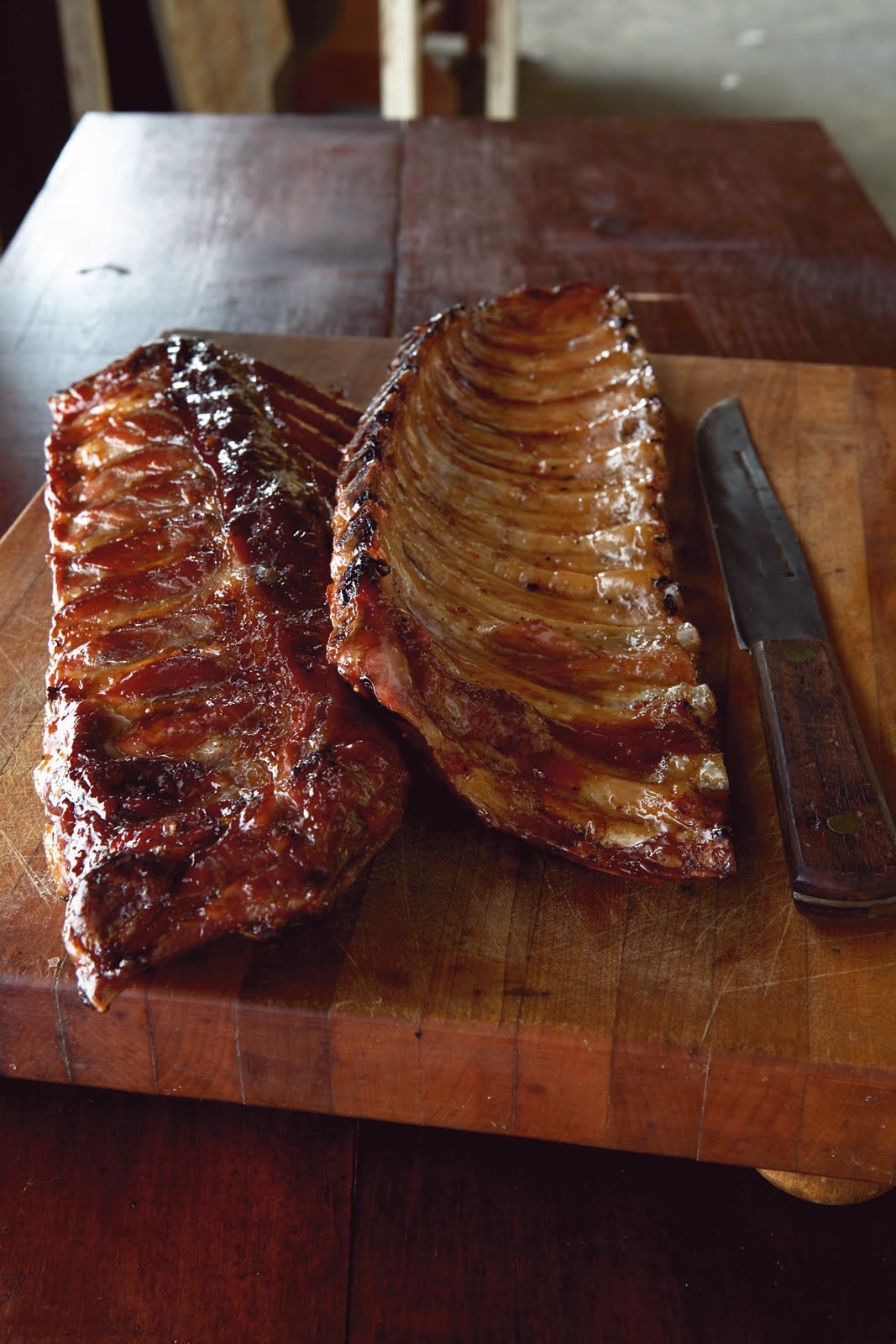
Coca-Cola–Glazed Baby Back Ribs
Makes about
20 pieces
Coca-Cola is to Atlanta as Guinness is to Dublin. Friends and family liked my Coca-Cola–Glazed Wings (page 24) so much that I decided to try a similar combination on pork. Pork has a natural affinity for sweet, rich caramel flavors. These “nouveau” Southern ribs are by no means traditional, but they are lip-smacking good.

Scotch bonnet peppers are intensely hot, but their fire is tempered by the sweetness of the sugar and Coke. To tone down the heat, substitute jalapeños instead.

1 cup Coca-Cola Classic
1/4 cup apple cider vinegar
11/2 cups firmly packed light brown sugar
2 Scotch bonnet chiles, chopped
2 racks baby back ribs (3 pounds total)
Coarse salt and freshly ground black pepper

To make the glaze, in a small saucepan, bring the Coca-Cola, vinegar, brown sugar, and chiles to a boil over high heat; reduce the heat to medium-low and simmer until syrupy, about 10 minutes. Decrease the heat to low and keep the sauce warm while the ribs cook.

Preheat the oven to 325°F. Liberally season both sides of the ribs with salt and pepper. Place the ribs on a broiler pan and bake for 30 minutes, glazing the ribs occasionally with the Coca-Cola mixture. Turn the ribs over and continue to cook for an additional 30 minutes, glazing occasionally, or until the ribs are tender and the meat is starting to pull away from the bone.

When the ribs are cooked through, set the oven to broil. Liberally spoon half of the remaining glaze over the ribs and broil until glazed a deep mahogany brown, 5 to 7 minutes. Turn over; repeat with the remaining glaze, an additional 5 to 7 minutes.

Serve immediately with lots of napkins.

*All recipes were reprinted with permission of Virginia Willis

Labels: , , , , , , ,

Friday, May 28, 2010

Grilled Whole Wheat Pizza Margherita

Memorial Day weekend is a great time to try our newest favorite recipe – Grilled Whole Wheat Margherita Pizza. It is important to roll the crust out VERY THIN, otherwise, the whole wheat crust is a little doughy.

Enjoy!

Whole Wheat Pizza Margherita

Crust:
3 ¾ c. white whole wheat flour
1 Tb. instant dry yeast
1 ½ tsp. instant dry yeast
12 oz. water, 120 degrees
1 Tb. honey
1 Tb. olive oil
2 tsp. seasoning mix
1 Tb. dried oregano
1 Tb. dried basil
½ tsp. cayenne

Method:
Bloom the water and the yeast for ten minutes and bubbly. Add the oil and the honey.

Add the rest of the ingredients. Mix with a dough hook until smooth (about 10 minutes). Let rise and double in a warm, draft free place (about an hour and a half).

Punch down and divide into three pieces. roll out on a lightly floured surface. Make sure that you roll them THIN.

Brush very lightly with oil and sprinkle with a light sprinkling of seasoning mix. Grill on each side.

Garnish the Pizza with fresh, sliced tomatoes, julienne of basil, and torn fresh mozzarella cheese. Put into the oven for a few minutes to melt the cheese. Serve with a light drizzle of extra virgin olive oil & a sprinkle of seasoning mix.

Labels: , , , , , , , ,

Wednesday, May 19, 2010

A Chef Obsessed with Food - "Naturally"

Every chef has a love affair with food. We have the awakening – a knowledge that there is more to life than eating to live, or eating food that’s “just ok”. Then, there’s the exploration phase, eating, tasting and cooking all different types of foods and ingredients. Soon, courtship, the world of professional cooking is exciting and emotional. Once swept into the scene, we’re all but done for, addicted to the adrenaline, the heightened senses, the romance, the dance; now we’re committed.

The honeymoon phase begins, everything is as intoxicating as the scent of fresh vanilla beans and good quality bourbon. As we pass through the honeymoon stage, we settle comfortably into our relationship with our career and then… some of us might get a little restless. There’s nothing “wrong” per se, but there’s the inkling that there’s something “more”. Foods we haven’t tasted, ingredients we’ve never seen up close, meals we haven’t indulged in. Curiosity is piqued and we often start looking at other options, having grown tired of what we’ve relied on to satisfy our palates and senses up until just then.

The thing about food is that it’s all been done before. I’m always appalled to hear chefs refuse to give “their” recipes to other chefs or their well-intentioned groupies. It’s as if these chefs think they’ve really invented that particular dish themselves. Last I checked, none of them were named “Careme” or “Escoffier”, which means, with very few exceptions, no one’s recipe or cooking technique is actually original.

All of that aside, I, myself, find that I tire of certain cooking techniques or only eating a certain range of foods, and have ventured off into what some consider the “fringe” aspects of the culinary realm. After a trip to the now defunct Capital Poultry, I found myself an instant vegetarian. Once meat-free, I gradually went vegan. At about that same time, I ceased eating cane sugar products, and instead used sweeteners like maple and barley malt syrups, agave nectar, etc. (avoiding honey, though, since it is technically not a vegan food). After about 3 years of this, my lifestyle was derailed by a month’s long craving for a corned beef sandwich, and it has taken me 5 years to get back on the veg-friendly track, which I am happily 95% on once again (I eat a limited variety of seafood).

Once again, I’ve found myself in a restless exploration phase. Tired of preparing the same types of foods, I long to learn more about whole grains and to reacquaint myself with natural “cane-free” sweeteners – even better – explore the culinary world without “white foods”. Chefs are one part scientist, one part artist, and two parts obsessive. With all of the natural and sustainable foods on the market now, I am curious to develop recipes that are healthful, delicious, and “whole”. Think whole grain dinner rolls, fruit crisps with seeds and oat flour, and even transforming some of my favorite “refined” treats into something more nutritious and full of nuance.

My culinary philosophy has always been about eating “real food”, nothing “processed”, and this is just a continuance of that ideology. Sure, cane sugar is natural, but anyone can make something delicious with cane sugar or white flour. The real challenge I’m taking on is making irresistible foods with some of the homelier ingredients we find in the grocery store.

After some tinkering around in the Mirepoix Cooking School kitchen (our very own “test kitchen/laboratory” I’ve come up with this Blueberry Crumble recipe we’ve enjoyed this week. This recipe still uses some cane sugar derivatives, but none of them are refined white granulated sugar. I hope you enjoy it as much as we have.

Blueberry Crisp

Blueberry mixture:
2 lb fresh blueberries
4 tablespoons cornstarch
2tablespoon finely grated fresh lime zest
2 tablespoon fresh lime juice
1/2 teaspoon ground cinnamon
1/2 teaspoon salt
1 cup. Sucanat

Topping:
1/2 c. oat flour or whole wheat flour
1 1/3 c. old fashioned rolled oats
1 c. Muscovado sugar
2 tsp. cinnamon
1/4 tsp. sea salt
1 c. chopped pecans, toasted
½ c. pumpkin seeds, toasted
½ c. canola oil

Method for the blueberry mixture –
combine all of the ingredients in a bowl and mix to just combine. Do NOT use frozen blueberries in this recipe! Set aside and prepare the topping.

Method for the topping -
Combine all dry ingredients together with a fork until uniformly moistened. Add oil and mix.

Place the blueberry mixture in individual ramekins or a 8X8 casserole dish. Top with the crumb mixture. Bake at 350 until bubbly, about 30 minutes.

Labels: , , , , , , ,

Friday, May 7, 2010

Just Say "No" to Cooking with "EVOO"

You might know it as that really yummy stuff called, “EVOO”. Chefs still call it “extra virgin olive oil”. Regardless of how you refer to it, extra virgin olive oil has been around for centuries, even though it seems like Rachel Ray just invented it.

Olive oil has a rich culinary and even medicinal history dating back to ancient times. There are countless different types of olive oil, and even more brands! When shopping for olive oil, you might find oils infused with figs, lemons, oranges, herbs and numerous other flavoring agents. Each brand might come from a different country – Spain, Italy, Greece, even the United States (California). Labels might read “cold press”, “first cold press”, “pure”, “light”, “blended” and more! So many choices - What’s a 30 minute meal warrior to do?

The simple (and wrong) answer is to just use “EVOO”.

Without overcomplicating matters, there are a few things you want to keep in mind when you’re selecting olive oil: Ask yourself what are you using it for and also taste.

1). ‘What are you using it for?” –
When thinking of cooking with olive oil, it makes sense to consider the “smoke point”. All oils have a smoke point. Simply put, the smoke point is the temperature at which the oil will start to smoke. This is the stage at which the heated fats begin to emit smoke and odors, which will impart an unpleasant taste to whatever you are preparing.

Butter has a smoke point of 350 degrees, while lard is higher at 361. Vegetable oil, peanut and safflower oils are much higher (441). Olive oil is 375. For this reason, it is sometimes better to use different types of oils for different applications. For example, if you are going to make a batch of hand-cut french fries, peanut oil is an excellent choice.

Another reason to avoid cooking with extra virgin olive oil is that olive oil has chlorophyll, and, when exposed to high temperatures, the chlorophyll will turn bitter. Because true extra virgin olive oil is so expensive, it is unwise to use extra virgin olive oil for sautéing because the flavor turns bitter when it reaches the right temperature for a sauté.

This isn’t to say that cooking with olive oil is wrong. Think of it like this- you wouldn’t use your best bottle of Dom Perignon to make a zabaglione; anything that made that champagne so special and unique is cooked out of the recipe before you can even taste it. The same would be true of using one of your best bottles of wine to deglaze a pan- it just doesn’t make sense. If you’re going to use olive oil as a cooking oil, consider using pure or a blended olive oil and consider the smoke point to determine which cooking techniques are appropriate.

Extra virgin olive oils are best used for drizzling, dipping, or enjoying in a dressing. Since these applications are not exposed to heat, the delicate and interesting flavors of the oil can really be appreciated.

2). Taste –
At Mirepoix, we use Acedemia Barrilla olive oils and balsamic vinegars. I like AB because of its clean, fresh flavor. Last week, someone brought in a different kind and when one of our students used it to make a vinaigrette, it was almost inedible! It took a lot of doctoring up to take away the bitter, “green” awful taste!

There are many very good tasting and high-quality olive oils on the market, but be selective, and don’t skimp! Good food starts with good ingredients. A $4 bottle of balsamic vinegar will TASTE like a $4 bottle of balsamic vinegar! The same principle applies to olive oil, and a million other ingredients. If your ingredients do not taste good on their own, a combination of inferior ingredients will not taste good either.

This summer, we will be featuring a series of free classes and tastings at Mirepoix. Our first tasting will be olive oils. For more information about Mirepoix, visit our website at www.mirepoixcookingschool.com. If you’d like to be notified when the free tastings begin, sign up for our email newsletter on our homepage or become a fan of Mirepoix Cooking School on Facebook.

Labels: , , , , , ,

Sunday, May 2, 2010

Culinary Herbs

Soon our local farmer’s markets will be springing up in communities all over Michigan with fruits, vegetables, farm-fresh eggs, chickens, and many other things that spark a curious cook’s imagination. Culinary herbs can also be found amongst the roses, ferns and other foliage available. Cooking with herbs is a terrific way to add flavor and nuance to your food without adding extra calories and fat.

Basil, parsley, thyme & rosemary are perhaps the most common herbs that people grow in their pots and window boxes, but there are many other herbs that will flourish in your culinary garden. Consider adding oregano or lemon thyme verbena as well.

As a general rule, I tell people to use fresh herbs whenever possible – even when it isn’t growing season. I can’t think of an instance when I ever use dried herbs. The flavor of fresh herbs is far superior to anything that is dried.

If your thumb isn’t green, you can always buy herbs in bunches at the grocery store. Most of the time, the herbs are sold in very large bundles that many people end up throwing away. To add life to your store bought herbs, simply fill a vase or a tall container with cold water and store your herbs, stem-end down in the refrigerator. Doing this will keep your herbs crisp and fresh.

To learn more about using herbs & spices, check out our class schedule at www.mirepoixcookingschool.com. Our upcoming class, “Marinades & Rubs” will feature recipes that will use a multiplicity of herbs to enhance your recipes. To get you started, here is our favorite Basic Pesto recipe. Remember – a recipe is only a guideline! Feel free to make changes to suit your tastes!

Basic Pesto –
4 cups loosely packed basil leaves
*do not use stems

3 cloves garlic, smashed
¾ cup pine nuts, toasted
1 cup grated Parmigiano Reggiano
*DO NOT use any other type of Parmesan cheese!

2 teaspoons Academia Barilla balsamic vinegar (or to taste)
salt, to taste
white pepper, to taste
1 cup Academia Barilla olive oil

Method:
Place basil, garlic, and pine nuts into the bowl of a food processor; puree until smooth. While the machine is running, drizzle in oil, using enough to make a paste. Add cheese and just pulse briefly to combine. Season with salt, pepper, and vinegar to taste. Store up to a week in an air-tight container or freeze up to three months.

Labels: , , , , , , , ,

Saturday, April 24, 2010

Organics

It’s no longer uncommon to hear the phrase “farm to table” or “farm to plate”, which refers largely to local foods. Organics, on the other hand, are a much bigger business.

The word "organic" refers to the way farmers grow fruits, vegetables, grains, dairy products and meat, as well as other crops like cotton. Organic farming practices are designed to encourage soil and water conservation and reduce pollution. Farmers who grow organic produce and meat don't use conventional methods to fertilize, control weeds or prevent livestock disease.

Growing organic isn’t as easy as just casting the chemicals aside. Farmers who wish to grow organics must go through a lengthy years-long and expensive process to rid the soil of any chemicals that may have been in the soil from previous use or exposure before growing anything that can be considered as “organic”. Because of this, organics cost more to grow than their conventional counterparts. Also, there is more loss per crop because organics do not have the protection against pests and spoilage that conventionally grown products do.

Organics are regulated by the USDA, and are easy to spot with a voluntary
“certified organic” seal. These standards regulate how such foods are grown, handled and processed. Any farmer or food manufacturer who labels and sells a product as organic must be USDA certified as meeting these standards. The only exception to this is producers who sell less than $5,000 a year in organic foods are exempt from this certification.

There is much debate as to whether or not organic foods are healthier and safer for us to eat. Many people suggest that the pesticides and other chemicals used in conventional farming practices are toxic to our bodies as well as the planet. Others say that only certain fruits and vegetables are adversely affected by conventional farming practices and that other foods are perfectly safe and nutritious when grown conventionally.

Production volume is another thing cynics of organics site when weighing the pros and cons of organic vs. conventional products. Since there are billions of people to feed, some argue that an organic farm system couldn’t produce enough food to feed the planet. By contrast, foods grown conventionally are much more available and productive in terms of yield.

The environment is also a consideration that many advocates of organics reference when making their argument in support of chemical free farming. Since organics are grown without the use of harsh chemicals, there is no “run off” of the chemicals into our lakes, rivers, etc.

Whether it be the environment, food supply, or health concerns, many people see the value of buying and consuming organic products either exclusively or a combination of conventionally produced and organic items. As you can see, food can be a very substantial political and emotional issue for many people, and we’ve just scratched the surface. Our next post will discuss the local food movement. Until then, whether conventional or organic, if it’s not food – don’t eat it!

Labels: , , , , , , ,

Saturday, April 10, 2010

Quick Weeknight Meal Options - Flank Steak

Incredibly easy to prepare and delicious, flank steak is a chef’s top choice for creating versatile, simple, and flavorful dishes that can be cooked quickly and with minimal effort. Flank steak is popular in Argentina, where it is known as vacio, and also in Mexico where it is known as arrachera. French chefs are quite partial to this cut known as bavette. Flank steak is also widely used in Asian cooking, often marinated with cornstarch, oil and other flavorings, and then quickly stir-fried.

As its name indicates, flank steak is cut from the flank, a muscle from the belly. It can be somewhat tough because this is a well-exercised muscle. A lean cut of meat, flank steak should not have much marbling, and should have a bright, red color.

Flank steak is commonly marinated before it is prepared, simply because marinades offer an additional layer of flavor, but also because the acid (vinegar, wine, lemon juice, etc.) used in the marinade tenderizes the meat, making it even more palatable. Flank steak should be marinated for 30 minutes before cooking, or up to 3 hours. Do not exceed 3 hours, or the meat will have an overpowering flavor from the marinade, and the texture will be unsatisfactory.

Flank steak can be grilled, broiled (it was the original cut of meat used to prepare the classic London Broil), sautéed, or stir-fried. It is less commonly braised. No matter which cooking method you use, it is essential to avoid overcooking the meat. When overcooked, flank steak will have a very tough, rubbery texture, and will be unpleasant to eat. It is recommended to serve flank steak rare or medium rare, so as to preserve its tender texture.

Grilled flank steak is a delicious choice for fajitas, a perfect addition to a chopped salad with crumbled blue cheese and dried cherries, an irresistible baguette sandwich with cherve and freshly dressed greens, or served grilled with roasted potatoes.

You can prepare quick and delicious weeknight meals that you & your family will make time and time again in our Quick Weeknight Meals class on April 19. To register, go to www.mirepoixcookingschool.com

Labels: , , , , ,

Friday, April 9, 2010

Sharpen Your Skills in the Kitchen - Knife Skills 1.0

Our most common cooking class at Mirepoix is Knife Skills 1.0. Over the years, we’ve taught this class a myriad of different ways, and now I think we’ve found the best way to teach this very important topic. Our Knife Skills 1.0 class, like all of our other classes, is completely hands-on. Students learn best when they do it themselves instead of watching a demonstration-only format.

We also change our Knife Skills 1.0 class seasonally to feature ingredients that will be used in recipes that make sense for that particular time of year, so, even if you already took Knife Skills in the summer, we have something different to offer in the fall.

Knife Skills 2.0 features ingredients that are in season, but, more importantly, more difficult to prepare. We select produce and meats that people enjoy eating but may not know how to trim, slice and dice. Like Knife Skills 1.0, this class also changes twice a year to feature different seasonal ingredients.

Finally, Knife Skills 3.0 is our most advanced Knife course. This course outlines basic cuts of meat and proper “butchery” techniques. Learning how to cut and trim meat yourself is economical when money is tight.

Good cooking begins with good ingredients, but also the right tools, as discussed in an earlier post, “Tools of the Trade - Cook Like a Chef”. We recommend three knives to get you started – a chef’s knife, paring knife, and a boning knife. Of course there are other knives that you will eventually need, but we recommend starting with these three as they are the most commonly used.

Selecting a chef’s knife is important. Below you will find some tips to help you select the best knife for you.

Forged versus Stamped
The weight and balance of a chef's knife is said to depend on how the blade was manufactured. Forging, which involves pounding a relatively thick, red-hot billet of steel into shape under extreme pressure using a forging hammer and die, produces a slightly thicker, heavier blade. A forged knife also has a bolster, the thick piece of metal between the blade and the handle. A bolster adds weight, is said to improve the balance between the blade and handle, and can protect your fingers by separating them from the cutting edge.

Other knives have stamped blades, which began life as thin sheets of steel. Blade-shaped blanks are punched out on a huge press, almost like cookies being cut from rolled dough. Manufacturing techniques now allow bolsters to be attached to knives with stamped blades.

Heavy vs. Light
When you’re buying a knife, you are looking for something that feels good in your hand. It is nicely weighted, moves easily and feels balanced. We have a collection of both 8 and 10” Chef’s Knives, and each of the Mirepoix Cooking School staff has their preference for individual reasons. I prefer a 10” knife. I like the heavier weight and find it easy to use when cutting up hearty vegetables like hard squashes, melons, etc. Some others on my staff prefer the 8” because it is easier to use.

10” knives are heavier, so if that’s something you prefer, you might want to go with that. If you feel that the 10” is too large to handle, then the 8” is the right knife for you. A good knife, no matter the length, will be nicely weighted.

Price vs. Cost
A good knife is an investment. Most of my chefs have owned their knives since attending culinary school (for us that was about 10+ year ago). If you take good care of your knife, it is something you will be able to use for many, many years.

Caring for Your Knives – The 10 Commandments

1.Do NOT put your knives in the dishwasher
2.Do NOT use an electric sharpener to sharpen your knives
3.Do NOT store your knives in a drawer or in any other manner that would allow them to bump up against each other or something else
4.Do NOT put your knives in the sink
5.Do NOT take your knives to be sharpened by anyone who is going to “grind them”
6.Do NOT attempt to sharpen serrated knives
7.DO use the right knife for the job – not all knives are interchangeable
8.DO remember to sharpen your knife at least twice a year
9.DO use an oil stone to sharpen your knives
10.DO remember to use a steel on your knife at least every other time you use it

To learn more about the Mirepoix Cooking School or to register for a class, go to www.mirepoixcookingschool.

Labels: , , , , ,